If you buy through a partner link, we may earn a commission.

Best Fish Finders for Kayak Fishing in 2026

Updated on Feb 3, 2026

Kayak fishing demands a fish finder that is compact, power efficient, and readable in direct sun, while still delivering the sonar detail you need to separate fish from cover. In this list of the best fish finders for kayak fishing, we prioritize CHIRP target separation, high definition imaging like DownScan, ClearVü, or Down Imaging, reliable GPS waypointing, and transducers that mount cleanly on a kayak hull or gear track.

Best Overall
1
Humminbird HELIX 5 CHIRP GPS G3
9.6
ProductLust
Score

Humminbird HELIX 5 CHIRP GPS G3

  • Dual Spectrum CHIRP target separation makes real fish arches pop in cluttered water.
  • Built in GPS plus Humminbird Basemap is legit for waypointing ledges and weedlines.
  • AutoChart Live lets you build custom contour maps while you paddle and drift.
Check Price
From Amazon
2
Lowrance HOOK Reveal 5 SplitShot
9.3
ProductLust
Score

Lowrance HOOK Reveal 5 SplitShot

  • FishReveal overlay is a cheat code, CHIRP targets on top of DownScan structure.
  • Autotuning sonar saves time, it stays dialed when depth and speed keep changing.
  • SplitShot transducer is a clean kayak setup for below-boat detail without extra hardware.
Check Price
From Amazon
3
Garmin Striker Vivid 4cv
9.0
ProductLust
Score

Garmin Striker Vivid 4cv

  • Vivid palettes improve contrast fast, you read returns instantly in glare and chop.
  • CHIRP plus ClearVü makes brush, rock, and bait tighter and easier to interpret.
  • Quickdraw Contours is excellent for DIY lake mapping when charts are weak.
Check Price
From Amazon
Most Popular
4
Garmin STRIKER 4
8.8
ProductLust
Score

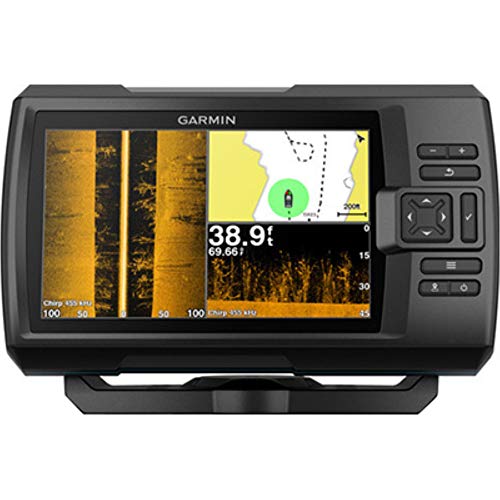
Garmin STRIKER 4

  • The gold standard starter unit, reliable CHIRP performance without menu headaches.
  • Built in GPS is perfect for marking launches, docks, and repeatable milk runs.
  • Tiny footprint fits cramped kayak decks and still reads well from a seated position.
Check Price
From Amazon
5
Garmin STRIKER Plus 7sv
8.7
ProductLust
Score

Garmin STRIKER Plus 7sv

  • SideVü and ClearVü add real search power when you want to scan, not just ping.
  • Bigger screen helps split views, ideal for running sonar plus map without squinting.
  • Quickdraw mapping plus GPS speed data is great for trolling and controlled drifts.
Check Price
From Amazon
6
Humminbird PiranhaMAX 4 Down Imaging
8.4
ProductLust
Score

Humminbird PiranhaMAX 4 Down Imaging

  • Down Imaging shows clean structure edges, you stop guessing what the blob is.
  • Simple keypad UI is fast, fewer settings to fight when the bite window is short.
  • Strong budget pick for shallow lakes, docks, timber, and nearshore rock transitions.
Check Price
From Amazon
7
Garmin STRIKER Cast with GPS
8.1
ProductLust
Score

Garmin STRIKER Cast with GPS

  • Zero mount drama, cast it, retrieve it, and you have sonar on your phone.
  • GPS mapping with Quickdraw style contours is surprisingly useful for bank-to-kayak scouting.
  • Best for minimalist rigs, travel kayaks, and quick sessions where wiring is overkill.
Check Price
From Amazon

References

  1. Best Kayak Fish FindersWired2fish
  2. What do you guys think the best fish finder for kayak fishing is?Reddit
  3. Best Kayak Fish FindersKayak Angler Mag

About this list

Last Updated
Feb 3, 2026
Number of items
7

How we came up with this list

ProductLust's reviewed multiple sources, including Wired2fish, Reddit and Kayak Angler Mag. These sources provide comprehensive reviews and ratings based on ease of use, portability and effectiveness. We identified models like the Humminbird HELIX 5 CHIRP GPS G3, Lowrance HOOK Reveal 5 SplitShot and Garmin Striker Vivid 4cv as the best options in this price range.

Frequently asked questions

The best fish finders for kayak fishing is a compact unit with CHIRP sonar, a bright display for sunlight readability, low current draw for 12V batteries, and a transducer that mounts cleanly on a kayak without creating drag. If you fish structure, prioritize down imaging or ClearVü style scanning. If you cover water, consider SideVü or SideScan for faster searching.

Yes, CHIRP is one of the biggest upgrades for kayak anglers because it improves target separation and reduces clutter compared to single frequency sonar. In practical terms, CHIRP helps you distinguish individual fish from bait and see fish tight to cover, especially when you are drifting or slowly paddling.

Traditional sonar commonly uses 83 kHz and 200 kHz, while scanning sonar uses 455 kHz or 800 kHz. Lower frequencies typically provide wider coverage and better deep-water performance, while higher frequencies provide sharper detail in shallow to mid depths. For most kayak fishing, you want the option to run a high CHIRP band plus a scanning frequency for crisp structure definition.

Down imaging or DownScan or ClearVü gives a high detail view directly beneath the kayak, ideal for identifying rock, timber, brush piles, and edges. Side imaging or SideScan or SideVü scans out to the sides, which is useful for finding targets faster without paddling over them. If you fish small spots and vertical presentations, down imaging is often the priority. If you fish large flats, points, and weed lines, side imaging is a major advantage.

GPS is a serious performance feature, not a luxury. Waypoints let you return to a brush pile, drop-off, or school you found on sonar, even when wind and current push you off. GPS also supports track lines, speed over ground for trolling control, and mapping features like depth shading or custom contour creation.

If you fish reservoirs, big lakes, or coastal water where navigation and repeatability matter, mapping capability is worth it. Built-in basemaps are fine to start, but the real value is accurate contour data, depth shading, and the ability to build your own bathymetry with tools like live mapping or contour recording.

A 4 to 5 inch screen is ideal for most kayaks because it is lightweight, easy to mount, and efficient on power. A 7 inch screen is a big upgrade for split screen views like sonar plus GPS, but it demands more space, stronger mounting, and usually more battery capacity. The best size is the one you can read instantly without leaning forward.

The cleanest installs use a kayak transducer mount or gear track system that keeps the transducer level and stable. In-hull mounting works only for traditional sonar on many plastic hulls, but it can weaken imaging performance, especially down imaging and side imaging, because scanning sonar wants a clear path. For best imaging, use a through-hull, over-the-side, or dedicated mounting plate that keeps the transducer in clean water flow.

Most kayak setups use a 12V battery, commonly LiFePO4 for low weight and stable voltage. Battery size depends on the unit’s current draw and your trip length. A typical full-day setup often lands in the 10Ah to 20Ah range for smaller units, while larger screens and imaging can justify more capacity. Always fuse the power lead and use marine-grade connectors to prevent voltage drop.

Keep power wiring clean, use a fused power line, avoid sharing the fish finder circuit with noisy accessories, and route transducer cables away from high-current wires. If you see speckling or vertical noise lines, check for poor connections, low battery voltage under load, or transducer cable pinch points. Adjusting sensitivity, noise rejection, and surface clutter settings can help, but wiring quality is the first fix.

Start with the correct frequency or CHIRP band, then set sensitivity so the bottom return is strong without filling the screen with clutter. Tune surface clutter and noise rejection only as needed. For scanning sonar, reduce range to match the depth and your search goal, and keep the kayak speed steady so the image does not smear.

Traditional 2D sonar is forgiving at low to moderate kayak speeds. Scanning sonar quality depends more on steady speed and stable transducer angle. If your imaging looks stretched or blurry, slow down and ensure the transducer is level. Wind-driven yaw can distort side imaging more than speed alone.

FishReveal style features overlay CHIRP fish targets on top of down imaging returns. It helps in real kayak scenarios when fish are close to brush or rock and the down imaging view makes fish harder to interpret. It can make decisions faster because you get structure clarity and fish targets in one view.

Castable sonar can work well for minimalist kayak rigs, travel kayaks, and quick sessions, especially for scouting depth and finding bait. The tradeoff is reliance on a phone display, Wi-Fi or Bluetooth performance, and less consistent transducer positioning compared to a fixed mount. For serious structure fishing, a dedicated head unit with a hardwired transducer is usually more reliable.

For shallow water, prioritize higher frequency detail, fast refresh, and clear imaging of grass edges, shell beds, and docks. A compact unit with CHIRP plus down imaging is often the sweet spot because you get fish separation and crisp structure definition without a heavy power draw.

For deep water, prioritize CHIRP performance, a stronger bottom lock, and frequency options that hold bottom at depth. GPS becomes more valuable for returning to offshore humps, ledges, and channel swings. A larger screen can help with split views so you can track depth and structure while navigating to waypoints.

A 4 inch fish finder is absolutely good enough if it has CHIRP and a clear display. It is often the best choice for small kayaks because it mounts easily, sips power, and still provides the core data you need to find depth changes, bait, and fish. If you regularly run split screen or rely heavily on mapping, moving up to a 5 or 7 inch screen is a noticeable upgrade.

Focus on verified performance features like CHIRP sonar, down imaging or ClearVü or DownScan, GPS waypointing, and a transducer that matches your mounting plan. Then check practical kayak criteria like current draw, IPX7 or better water resistance, mount compatibility with gear tracks, and whether replacement parts and transducer hardware are easy to source.